Name if the Art of Chinese Wood Paper Carvings

Much traditional Chinese art was made for the regal courtroom, often to be then redistributed equally gifts. As well as Chinese painting, sculpture and Chinese calligraphy, there are a cracking range of what may be called decorative or applied arts. Chinese fine art is distinguished from Chinese folk art, which differs in its style and purpose. This article gives an overview of the many different practical arts of China.
Calligraphy [edit]
The Chinese purple courtroom collected calligraphy pieces from the almost skilled calligraphers in the land. The drove contains many masterpieces made by well-known calligraphers throughout Chinese fine art history. Furthermore, because of calligraphy'south high creative value, calligraphy collecting was popular among several Chinese emperors in multiple dynasties.

Ceramics [edit]
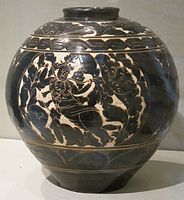
Chinese ceramics, whose history originates back to the pre-dynastic periods, has continuously improved since and then, and it is one of the near significant forms of Chinese art.

Snuff bottle [edit]
After opium was introduced to China, snuff bottles became popular. The Chinese royalties were addicted to them, every bit they used opium as a long-life medicine. The design of the snuff bottles flourished because of the coin that the rich poured into the industry. Many of these bottles were made by talented artisans using tiny paints brushes; they were painted from inside of the bottle, reaching down from the top of the narrow neck. They are still highly collectible up to this day.[ commendation needed ]
Cloisonné [edit]


Engraving [edit]
Glassware [edit]
Jewellery [edit]

Lacquer [edit]
It was during the Shang dynasty (c. 1600–1046 BCE) when the sophisticated techniques used in the lacquer process were starting time developed, and it became a highly artistic craft.[ane] Various prehistoric lacquerware have been unearthed in Mainland china dating dorsum to the Neolithic menstruation.[1] The earliest extant lacquer object, a red wooden basin,[2] was unearthed at a Hemudu culture (c. 5000–4500 BCE) site.[3] By the Han dynasty (206 BCE – 220 CE), many centers of lacquer product had become established.[1] The knowledge of the Chinese methods focusing on the lacquer procedure spread from China during the Han, Tang, and Song dynasties. Subsequently on, information technology was somewhen introduced to the residual of the globe—Korea, Japan, Southeast and Southern asia.[four]
-
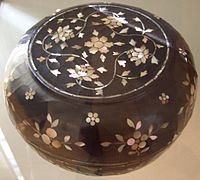
Chinese mother of pearl lacquer box with peony decor, Ming dynasty, 16th century, Museum für Lackkunst, Münster (Germany)
-

Coromandel lacquer screen with figures in pavilions and a main border with a "hundred antiques".
-

Painting [edit]
-

-
-
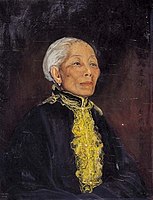
Portrait of Madame Liu, Li Tiefu, 1942, oil on canvas
Photography [edit]
After the invention of photography in 1839 and the arrival of European photographers in Macao, photography was soon introduced in several cities in Prc. At first, some people were reluctant because they thought that having the camera take a pic of them would event in their spirit being taken away. Only, by the cease of the nineteenth century, all major cities had photographic studios. Some flush Chinese people even adopted photography every bit a hobby. Western and Chinese photographers documented ordinary street life, major wars, and prominent figures.[ citation needed ]
-
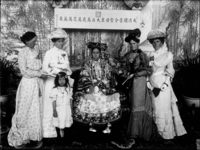
The Cixi Imperial Dowager Empress of Prc
The Empress Dowager Cixi had her portrait taken repeatedly.
Sculpture and carving [edit]
In the 18th Century, a Qing dynasty covered vase depicting a woman belongings a lingzhi fungus and a peony branch was created. The woman was also accompanied by a boy, a crane, and a deer equally shown below.[ citation needed ]
Ivory carving [edit]
Ivory was not a prestigious material in the rather strict hierarchy of Chinese art, where jade had always been far more highly regarded, and rhinoceros horn (which was not ivory) had a special auspicious meaning.[5] But ivory, also as bone, had been used for various items since early on times when China still had its own species of elephant. Demand for ivory seems to accept played a large part in their extinction, which came before 100 BC. During the Ming dynasty, ivory began to be used for pocket-sized statuettes of gods and others (see gallery). In the Qing dynasty, information technology suited the growing taste for intricate carving and became more than prominently used for brush-holders, boxes, handles and similar pieces. Subsequently on, Canton even developed large models of houses and other large and showy pieces, which remained pop.[6] Enormous examples are still seen every bit decorative centrepieces at government receptions. Figures were typically uncoloured, or just with certain features coloured in ink which was oft just black, but sometimes a few other colors.[ citation needed ]
-

A Chinese ivory tabular array screen with carved decoration of an outdoor scene, from the Qing dynasty, dated to the reign of the Qianlong Emperor (1735–1796).
Authorities seals [edit]
Seal knob (紐刻) is an fine art that originated in aboriginal Mainland china and is mainly popular in East Asian countries. It focuses or decorates on the head-function or the top-side of a seal. It is a kind of sculpture or mini-sculpture. In China, the utmost important seal of all is the imperial seal carved from the Heshibi, a sacred formalism jade. It was said that the greenish jade took the form of a round shape with inscriptions that read "Having received the Mandate from Heaven, may (the emperor) pb a long and prosperous life." (受命於天,既壽永昌) This was said to exist written by the Primer Li Si for Qin Shi Huang Zhao Zheng, the Augustus Emperor of The Chinese Empire.[ citation needed ]

Ruyi [edit]
Ruyi is a scepter that serves primarily as a decoration. Its history began in the Qing dynasty when Ruyi scepters were given to noted visitors of the emperor. Now, they're given every bit birthday presents. Ruyi is made of different materials, including porcelain and jade. The term Ruyi ways "may your wish exist granted" or "as you wish". The unusual shape is meant to imitate the shape of a stemmed lotus flower.[seven]
Stone carving [edit]
Woodwork [edit]

Fabric arts [edit]
Embroidery [edit]
Chinese embroidery is one of the oldest extant needlework. The four major regional styles of Chinese embroidery are Suzhou (Su Xiu), Hunan (Xiang Xiu), Guangdong (Yue Xiu) and Sichuan (Shu Xiu). All of them are nominated as Chinese Intangible Cultural Heritage.[ commendation needed ]
-

Gilded pheasant rank badge, 2nd rank civil servant, silk tapestry with painted details. Red china, Qing dynasty, late 18th – early 19th century. Denver Art Museum
-
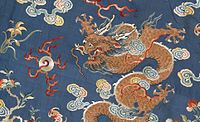
Detail of qifu (imperial dragon robe), tardily 19th or early on 20th century, silk, gilt thread, twill and damask weave, embroidery, Honolulu Academy of Arts
-
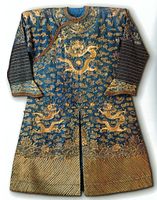
Chinese summertime court robe ("dragon robe"), c. 1890s, silk gauze couched in gilded thread, East-West Center
Rugs [edit]
Woven material [edit]
-
Detail of qifu (imperial dragon robe), late 19th or early 20th century, silk, gilded thread, twill and damask weave, embroidery, Honolulu University of Arts
See also [edit]
- Academies
- People's republic of china Academy of Art
- Cathay Cardinal University of Fine Arts
- Hubei Constitute of Fine Arts
- Chinese architecture
- Chinese folk fine art
- Chinese furniture
- Chinese garden
- Collections of fine art in China
- National Art Museum of China
- National Museum of Cathay
- National Palace Museum, Taipei
- Forbidden City (Palace Museum)
- Summer Palace, Beijing
References [edit]
- ^ a b c Webb, 2000. p. 3.
- ^ Stark, 2005. p. 30.
- ^ Wang, 1982. p. 80.
- ^ Institute, ed., 1983. p. 211.
- ^ Rawson, 179–182.
- ^ Rawson, 182.
- ^ Ruyi Gotheborg.com Retrieved xxx August 2012.
Bibliography [edit]
- Chang, Zonglin. Li, Xukui. (2006). Attribute of Chinese culture. 中国文化导读. 清华大学出版社 publishing
- Institute of the History of Natural Sciences and Chinese Academy of Sciences, ed. (1983). Aboriginal China's engineering science and scientific discipline. Beijing: Foreign Languages Press. ISBN 978-0-8351-1001-three.
- Rawson, Jessica (ed). (2007). The British Museum Book of Chinese Art, (2d edn). British Museum Press. ISBN 978-0-7141-2446-9
- Stark, Miriam T. (2005). Archaeology of Asia. Malden, MA : Blackwell Pub. ISBN ane-4051-0213-6.
- Wang, Zhongshu. (1982). Han Culture. Translated by Chiliad.C. Chang and Collaborators. New Oasis and London: Yale Academy Press. ISBN 0-300-02723-0.
- Webb, Marianne (2000). Lacquer: Engineering science and conservation. Oxford: Butterworth-Heinemann. ISBN 978-0-7506-4412-9.
Source: https://en.wikipedia.org/wiki/Chinese_art_by_medium_and_technique
0 Response to "Name if the Art of Chinese Wood Paper Carvings"
Post a Comment